
Published on: October 8, 2015 | Updated on: October 30, 2025
One of the regulations associated with the new TRID forms is a 3-day rule. The 3-Day rule mandates borrowers MUST receive the Closing Disclosure 3-days before the closing date. This new rule gives consumers the opportunity to review the closing disclosure and ensure all information is correct and correlates with the Loan Estimate.
However, what happens if any changes need to be made?
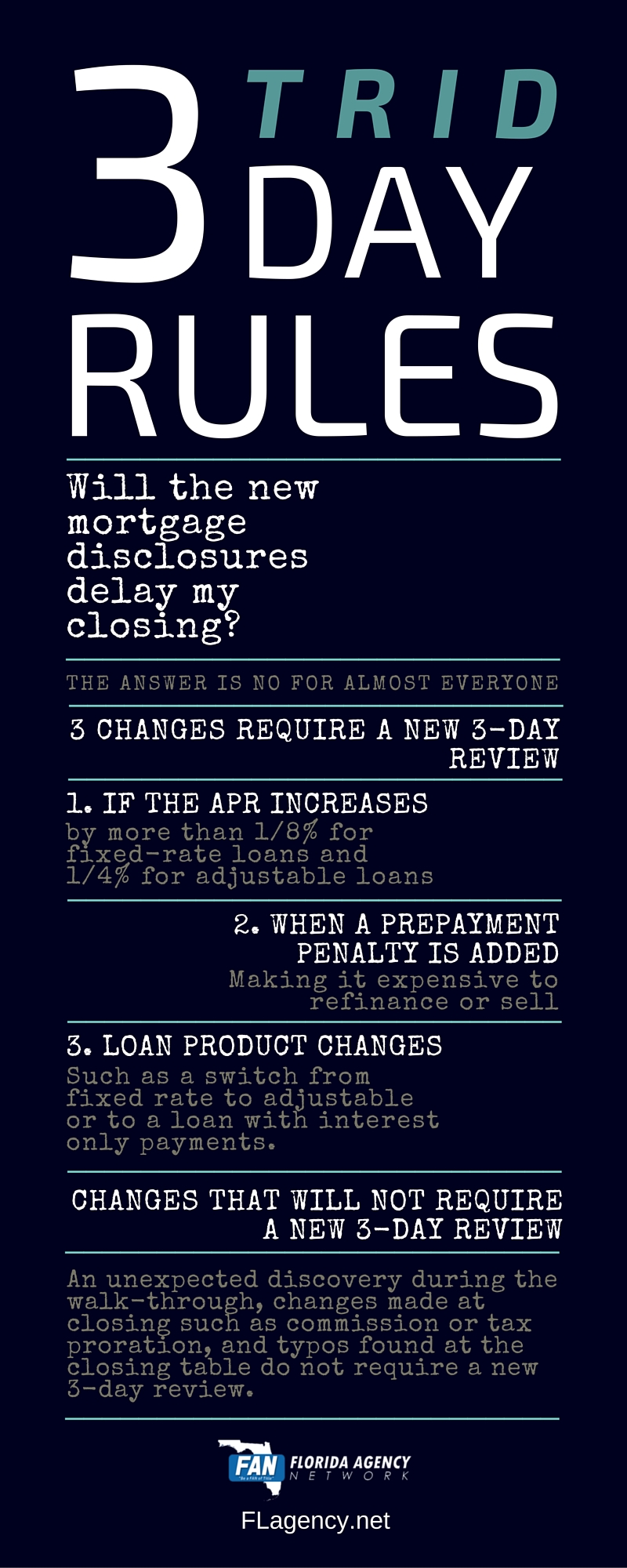
The infographic below explains three situations that would require a new closing disclosure and thus, delay your closing.
Navigating mortgage regulations can feel overwhelming, especially when timing is everything in a real estate deal. At Florida Agency Network, we've helped countless clients in the Sunshine State steer clear of unnecessary hurdles. If you're dealing with a closing soon, understanding these details could save you time and stress. For more insights on post-TRID contract strategies, check out our guide on 3 things to keep in mind when writing contracts post-TRID.
As we move further into 2025, the mortgage landscape continues to evolve under the watchful eye of the Consumer Financial Protection Bureau (CFPB). While the core TRID framework - combining the Truth in Lending Act (TILA) and Real Estate Settlement Procedures Act (RESPA) - remains steadfast since its 2015 rollout, recent adjustments aim to refine transparency and consumer protection. For instance, the CFPB's final rule on Property Assessed Clean Energy (PACE) financing, issued in late 2024, now treats these energy-efficient home improvement loans more like traditional mortgages, requiring integrated disclosures to avoid surprises at closing.
In Florida, where real estate moves fast amid booming markets in areas like Miami and Orlando, staying compliant means adapting to both federal tweaks and state-specific nuances. The state's unique property tax proration rules and high volume of condo transactions add layers to TRID adherence. A key update for 2025 includes threshold adjustments under Regulation Z, where the exemption for certain appraisals rises to $71,900, potentially streamlining processes for lower-value loans but demanding vigilant documentation to prevent oversights.
Beyond thresholds, the CFPB's spring 2025 regulatory agenda emphasizes qualified mortgage reforms, shifting from strict debt-to-income ratios to annual percentage rate limits for safer lending practices. This could ease access for Florida borrowers with variable incomes, such as seasonal workers in tourism hotspots. However, it also heightens the need for precise initial Loan Estimates to match final Closing Disclosures.
Florida professionals should prioritize ongoing training, as TRID compliance remains one of the most common violation areas in mortgage lending. Top-cited issues often involve errors on Closing Disclosures, as noted in Federal Reserve compliance examination data from Consumer Compliance Outlook. To mitigate risks, integrate automated tools for fee calculations and collaborate closely with title agencies like those at Florida Agency Network, which are well-versed in Florida's FAR/BAR contracts that allow for closing extensions of up to seven to ten days if TRID delays arise.
Timing is critical under TRID, and 2025 brings renewed focus on flexibility without compromising protections. The standard requires delivering the Closing Disclosure at least three business days before consummation, but valid changed circumstances - like a borrower's request for a different loan term or unexpected appraisal findings - can trigger revised disclosures. In Florida, where hurricanes or title issues might delay inspections, lenders can extend timelines if documented properly. For example, if a natural disaster qualifies as an extraordinary event, it permits a reset without penalties, per CFPB guidelines. Always mail or email disclosures with proof of receipt to avoid disputes; electronic delivery, now more common post-pandemic, must include consumer consent. Pro tip: Build in buffer days during contract negotiations to align with Florida's variable closing customs, reducing the chance of rushed amendments.
No one wants to face fines, but understanding penalties encourages proactive compliance. Under the CFPB's 2025 inflation adjustments, civil penalties for TRID violations escalate across tiers. For any basic violation, such as failing to provide timely disclosures, the Tier 1 penalty stands at $7,217 per day. Reckless infractions jump to $36,083 per day under Tier 2, while knowing violations hit Tier 3 at a staggering $1,443,275 per day. Specific to TILA components of TRID, first-time breaches for mandatory ability-to-repay rules carry $14,435, with subsequent ones doubling to $28,866.
In Florida, where state oversight from the Office of Financial Regulation complements federal rules, penalties can compound with additional scrutiny. A 2020 CFPB assessment found that while TRID enhanced consumer understanding of loan costs - with borrowers reporting 15-20% better grasp of terms - it also increased industry compliance costs by about $100 per loan on average. To dodge these hits, conduct regular internal audits and partner with experienced title networks. If you're unsure about your setup, reach out to us at Florida Agency Network for a complimentary review - our team can spot potential gaps before they become costly.
Overall, these 2025 refinements underscore the importance of precision in Florida's dynamic market. By focusing on clear communication and robust systems, lenders and agents can turn potential pitfalls into seamless closings.
Staying ahead of redisclosure requirements is vital in 2025, particularly as new financing options like PACE loans integrate into TRID frameworks, potentially introducing complexities in loan terms. Under Regulation Z, three specific changes mandate a revised Closing Disclosure and a fresh three-business-day review period to protect consumers from last-minute surprises: significant APR increases (more than 0.125% for fixed-rate loans or 0.25% for adjustable-rate ones), the addition of a prepayment penalty that could penalize early payoff or refinancing, and switches in loan products, such as moving from a fixed-rate to an adjustable-rate mortgage.
These triggers, unchanged since TRID's 2015 inception but reinforced in ongoing CFPB guidance, ensure borrowers have ample time to reassess terms. In Florida, where PACE programs for energy improvements are popular in counties like Broward and Palm Beach, mishandling these as add-ons could classify them as product changes, necessitating redisclosure - especially under the CFPB's December 2024 final rule requiring tailored Loan Estimates and Closing Disclosures for PACE transactions.
To comply, document any valid changed circumstances promptly, such as borrower-requested modifications or unforeseen fees from title searches common in Florida's flood-prone areas. Lenders should use model forms provided by the CFPB for PACE to avoid errors, and coordinate with title experts to flag triggers early. This approach not only dodges penalties but aligns with Florida's emphasis on transparent real estate dealings, helping close deals efficiently amid the state's active market.
APR Increases Beyond Tolerance Florida Example: A fixed-rate loan's APR rises by more than 0.125% due to underestimated property taxes in a high-value Miami condo deal. Solution: Issue a revised Closing Disclosure immediately and restart the three-day clock to ensure borrower review, documenting the change as a valid circumstance like new tax data.
Issue: Addition of Prepayment Penalty Florida Example: During refinance for a Tampa home, a lender adds a penalty clause mid-process to make refinancing or selling more expensive. Solution: Notify the borrower promptly, provide a new disclosure, and extend the closing if needed - always verify lender approval lists for title partners to prevent such oversights.
Issue: Loan Product Changes Florida Example: Switching from a fixed to adjustable-rate mortgage for an Orlando investment property to chase lower initial rates. Solution: Treat this as a major shift requiring full redisclosure and a fresh three-day period; use checklists to flag product swaps early in underwriting.
What Is the Purpose of the TRID 3-Day Rule? The rule ensures borrowers have time to review final loan terms, comparing them to initial estimates for accuracy and fairness.
When Does a Change Trigger a New 3-Day Review? Only specific major changes, like significant APR hikes or product switches, require it - minor tweaks, such as typo corrections, do not.
How Do 2025 Updates Affect Florida Closings? Adjustments like higher appraisal exemptions and PACE disclosure rules add layers, but Florida contracts offer extensions to accommodate.
Can Electronic Delivery Satisfy the 3-Day Requirement? Yes, with borrower consent and proof of receipt, it's a efficient option for fast-paced markets.
What Happens If a Violation Occurs? Penalties can accrue daily, so quick corrections and documentation are essential to minimize impact.
In the ever-shifting world of mortgage regulations, mastering the TRID 3-Day Rule is key to avoiding delays and building trust with clients. Whether you're a lender, agent, or borrower in Florida, partnering with a reliable title expert makes all the difference. Don't let compliance concerns slow you down - contact your local Florida Agency Network title agency location today for your personalized TRID audit and ensure every closing is seamless.

Please fill out form below