
Published on: October 8, 2015 | Updated on: October 30, 2025
One of the regulations associated with the new TRID forms is a 3-day rule. The 3-Day rule mandates borrowers MUST receive the Closing Disclosure 3-days before the closing date. This new rule gives consumers the opportunity to review the closing disclosure and ensure all information is correct and correlates with the Loan Estimate.
However, what happens if any changes need to be made?
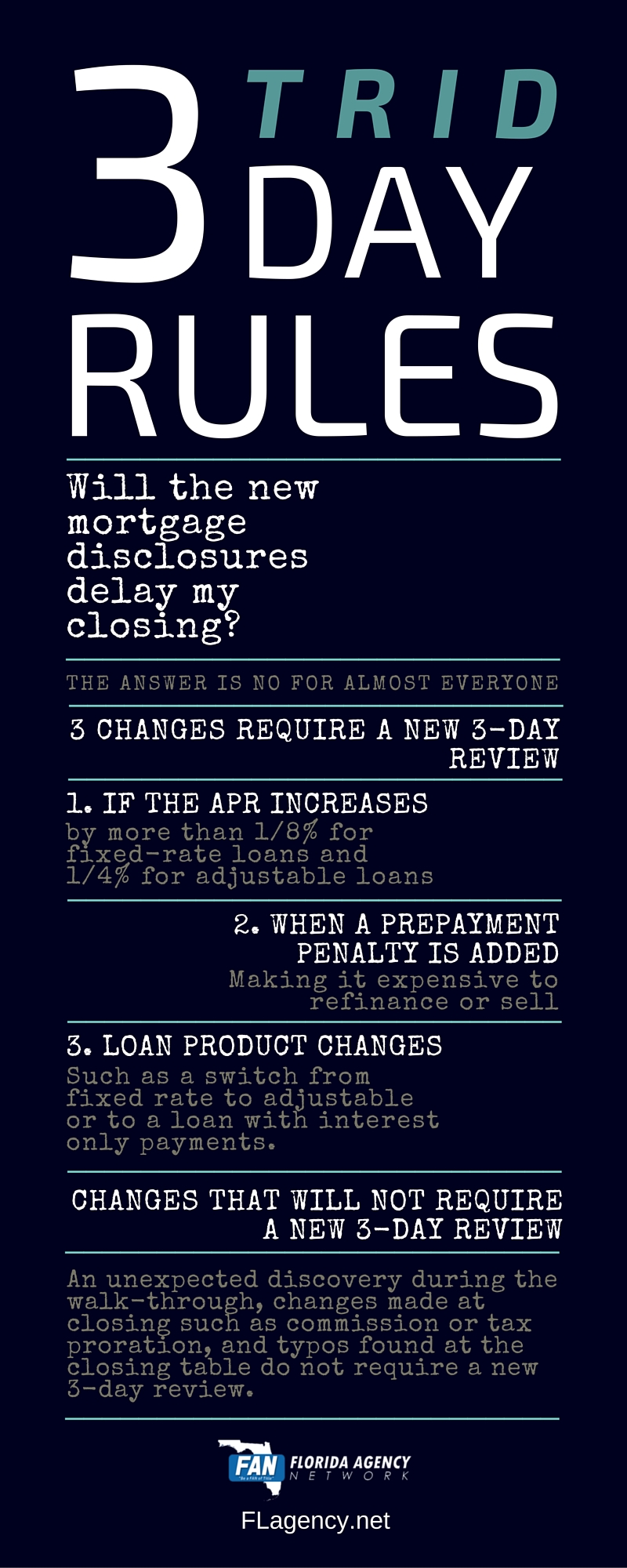
The infographic below explains three situations that would require a new closing disclosure and thus, delay your closing.
Navigating mortgage regulations can feel overwhelming, especially when timing is everything in a real estate deal. At Florida Agency Network, we've helped countless clients in the Sunshine State steer clear of unnecessary hurdles. If you're dealing with a closing soon, understanding these details could save you time and stress. For more insights on post-TRID contract strategies, check out our guide on 3 things to keep in mind when writing contracts post-TRID.
As we move further into 2025, the mortgage landscape continues to evolve under the watchful eye of the Consumer Financial Protection Bureau (CFPB). While the core TRID framework - combining the Truth in Lending Act (TILA) and Real Estate Settlement Procedures Act (RESPA) - remains steadfast since its 2015 rollout, recent adjustments aim to refine transparency and consumer protection. For instance, the CFPB's final rule on Property Assessed Clean Energy (PACE) financing, issued in late 2024, now treats these energy-efficient home improvement loans more like traditional mortgages, requiring integrated disclosures to avoid surprises at closing.
In Florida, where real estate moves fast amid booming markets in areas like Miami and Orlando, staying compliant means adapting to both federal tweaks and state-specific nuances. The state's unique property tax proration rules and high volume of condo transactions add layers to TRID adherence. A key update for 2025 includes threshold adjustments under Regulation Z, where the exemption for certain appraisals rises to $71,900, potentially streamlining processes for lower-value loans but demanding vigilant documentation to prevent oversights.
Beyond thresholds, the CFPB's spring 2025 regulatory agenda emphasizes qualified mortgage reforms, shifting from strict debt-to-income ratios to annual percentage rate limits for safer lending practices. This could ease access for Florida borrowers with variable incomes, such as seasonal workers in tourism hotspots. However, it also heightens the need for precise initial Loan Estimates to match final Closing Disclosures.
Florida professionals should prioritize ongoing training, as TRID compliance remains one of the most common violation areas in mortgage lending. Top-cited issues often involve errors on Closing Disclosures, as noted in Federal Reserve compliance examination data from Consumer Compliance Outlook. To mitigate risks, integrate automated tools for fee calculations and collaborate closely with title agencies like those at Florida Agency Network, which are well-versed in Florida's FAR/BAR contracts that allow for closing extensions of up to seven to ten days if TRID delays arise.
Timing is critical under TRID, and 2025 brings renewed focus on flexibility without compromising protections. The standard requires delivering the Closing Disclosure at least three business days before consummation, but valid changed circumstances - like a borrower's request for a different loan term or unexpected appraisal findings - can trigger revised disclosures. In Florida, where hurricanes or title issues might delay inspections, lenders can extend timelines if documented properly. For example, if a natural disaster qualifies as an extraordinary event, it permits a reset without penalties, per CFPB guidelines. Always mail or email disclosures with proof of receipt to avoid disputes; electronic delivery, now more common post-pandemic, must include consumer consent. Pro tip: Build in buffer days during contract negotiations to align with Florida's variable closing customs, reducing the chance of rushed amendments.
No one wants to face fines, but understanding penalties encourages proactive compliance. Under the CFPB's 2025 inflation adjustments, civil penalties for TRID violations escalate across tiers. For any basic violation, such as failing to provide timely disclosures, the Tier 1 penalty stands at $7,217 per day. Reckless infractions jump to $36,083 per day under Tier 2, while knowing violations hit Tier 3 at a staggering $1,443,275 per day. Specific to TILA components of TRID, first-time breaches for mandatory ability-to-repay rules carry $14,435, with subsequent ones doubling to $28,866.
In Florida, where state oversight from the Office of Financial Regulation complements federal rules, penalties can compound with additional scrutiny. A 2020 CFPB assessment found that while TRID enhanced consumer understanding of loan costs - with borrowers reporting 15-20% better grasp of terms - it also increased industry compliance costs by about $100 per loan on average. To dodge these hits, conduct regular internal audits and partner with experienced title networks. If you're unsure about your setup, reach out to us at Florida Agency Network for a complimentary review - our team can spot potential gaps before they become costly.
Overall, these 2025 refinements underscore the importance of precision in Florida's dynamic market. By focusing on clear communication and robust systems, lenders and agents can turn potential pitfalls into seamless closings.
Staying ahead of redisclosure requirements is vital in 2025, particularly as new financing options like PACE loans integrate into TRID frameworks, potentially introducing complexities in loan terms. Under Regulation Z, three specific changes mandate a revised Closing Disclosure and a fresh three-business-day review period to protect consumers from last-minute surprises: significant APR increases (more than 0.125% for fixed-rate loans or 0.25% for adjustable-rate ones), the addition of a prepayment penalty that could penalize early payoff or refinancing, and switches in loan products, such as moving from a fixed-rate to an adjustable-rate mortgage.
These triggers, unchanged since TRID's 2015 inception but reinforced in ongoing CFPB guidance, ensure borrowers have ample time to reassess terms. In Florida, where PACE programs for energy improvements are popular in counties like Broward and Palm Beach, mishandling these as add-ons could classify them as product changes, necessitating redisclosure - especially under the CFPB's December 2024 final rule requiring tailored Loan Estimates and Closing Disclosures for PACE transactions.
To comply, document any valid changed circumstances promptly, such as borrower-requested modifications or unforeseen fees from title searches common in Florida's flood-prone areas. Lenders should use model forms provided by the CFPB for PACE to avoid errors, and coordinate with title experts to flag triggers early. This approach not only dodges penalties but aligns with Florida's emphasis on transparent real estate dealings, helping close deals efficiently amid the state's active market.
APR Increases Beyond Tolerance Florida Example: A fixed-rate loan's APR rises by more than 0.125% due to underestimated property taxes in a high-value Miami condo deal. Solution: Issue a revised Closing Disclosure immediately and restart the three-day clock to ensure borrower review, documenting the change as a valid circumstance like new tax data.
Issue: Addition of Prepayment Penalty Florida Example: During refinance for a Tampa home, a lender adds a penalty clause mid-process to make refinancing or selling more expensive. Solution: Notify the borrower promptly, provide a new disclosure, and extend the closing if needed - always verify lender approval lists for title partners to prevent such oversights.
Issue: Loan Product Changes Florida Example: Switching from a fixed to adjustable-rate mortgage for an Orlando investment property to chase lower initial rates. Solution: Treat this as a major shift requiring full redisclosure and a fresh three-day period; use checklists to flag product swaps early in underwriting.
What Is the Purpose of the TRID 3-Day Rule? The rule ensures borrowers have time to review final loan terms, comparing them to initial estimates for accuracy and fairness.
When Does a Change Trigger a New 3-Day Review? Only specific major changes, like significant APR hikes or product switches, require it - minor tweaks, such as typo corrections, do not.
How Do 2025 Updates Affect Florida Closings? Adjustments like higher appraisal exemptions and PACE disclosure rules add layers, but Florida contracts offer extensions to accommodate.
Can Electronic Delivery Satisfy the 3-Day Requirement? Yes, with borrower consent and proof of receipt, it's a efficient option for fast-paced markets.
What Happens If a Violation Occurs? Penalties can accrue daily, so quick corrections and documentation are essential to minimize impact.
In the ever-shifting world of mortgage regulations, mastering the TRID 3-Day Rule is key to avoiding delays and building trust with clients. Whether you're a lender, agent, or borrower in Florida, partnering with a reliable title expert makes all the difference. Don't let compliance concerns slow you down - contact your local Florida Agency Network title agency location today for your personalized TRID audit and ensure every closing is seamless.
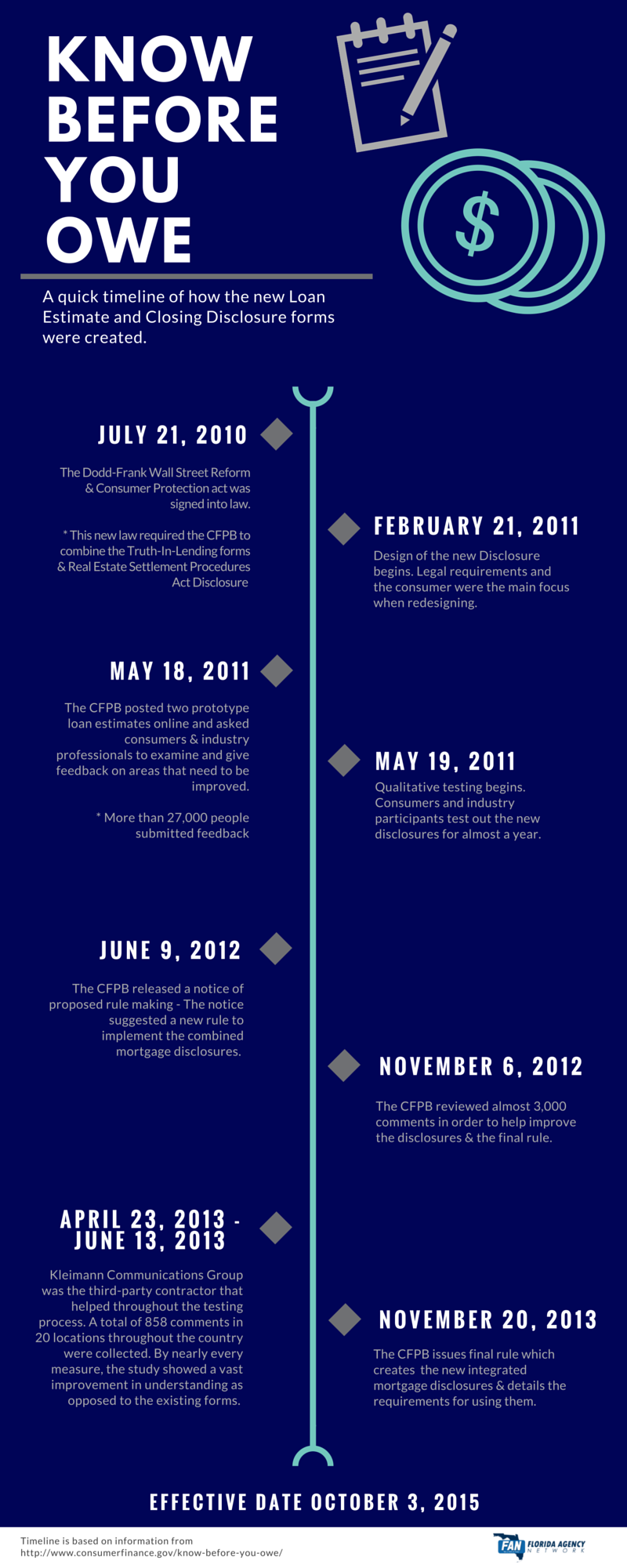
The new TILA-RESPA Integrated Closing Disclosure forms go live on Oct. 3 and will be a game changer for your business. However, do you know how the CFPB came up with TRID? We've got an early timeline of the process testing used to develop the new forms.
More Resources: 2025 TRID 3-Day Rule Updates: Compliance Tips to Avoid Delays
Page 4 of your Closing Disclosure is important. It is NOT just standardized form information that is identical for every loan.
Review these terms:
You should also review Escrow Account details to understand whether you will pay additional property costs via regular Escrow Account payments or handle them yourself directly.
Page 3 of your Closing Disclosure will compare cash requirements from your Loan Estimate to your actual final charges. If “Did this change?” is “YES” notes for changed sections should be provided.
The bottom line final “Cash to Close” is the money you will need in-hand in three business days.
If your transaction has a Seller the summary table will show a line by line comparison of Borrower to Seller transaction details.
If there is no Seller you may see a Payoffs and Payments table instead.
Review the summary tables to understand the transaction and your financial commitments at loan consummation.
Page 2 of your Closing Disclosure details specific closing costs.
Section A includes: Origination charges collected by the lender Origination fees paid to brokers, loan officers or other parties and Discount Points - prepaid interest. These figures should match your original Loan Estimate.
Section B covers services for which you could NOT shop. The total of these should be within 10% of the total from your Loan Estimate.
Section C covers services you could shop. If you chose providers from the lender’s written list, costs should be within 10% of Loan Estimate. The set of services you can shop may vary on different loans.
The Recording Fees in Section E should be within 10%; other costs in E, plus F, G and H, may vary from your Loan Estimate without tolerance limits.
This page will also break out the costs YOU will pay, before or at closing; the costs the Seller will pay, any costs paid by others and any credits from your Lender.
The first page of your Closing Disclosure documents:
If this loan has a penalty for pre-payment or includes a balloon payment Page 1 will summarize the terms.
Projected Payments will show the chief cost components - Principal & Interest, Mortgage Insurance and estimates of your Escrow Payments over the life of the loan. You may see different columns for different periods if changes in terms such as mortgage insurance change payment totals.
Closing Costs summarizes your loan closing expenses, and Cash To Close adds the additional amounts due to give you the cash balance you will need in 3 business days.
Click here to get more information on page 2 of the Closing Disclosure.
The Closing Disclosure documents the actual terms of your loan transaction. You should receive it no later than 3 business days before consummation. It must be in writing - paper or digital.
If the loan terms or costs change prior to consummation, your lender must provide a corrected disclosure AND an additional 3-business-day waiting period until loan consummation.
Waiving the 3-day waiting period is only permitted in certain circumstances, and only when the waiting period would cause a bona fide personal financial emergency.
Page 3 of your Loan Estimate includes measures to help you compare loans.
“In X Years” shows the total amount you will have paid in that time, and the dollar amount applied to your loan principal. The ratio between total paid and principal reduced may change over time.
The APR shows interest PLUS fees as an annual ratio - APR is the actual percentage this loan costs per year.
The TIP figure relates the interest you will pay over the life of the loan to the loan amount. For example - a TIP value of 25% on a $100,000 loan means you will pay $125,000 - $100K principal plus $25K interest - over the life of the loan.
Page 2 of the Loan Estimate provides the current ESTIMATED cash to close. Some costs will stay the same between estimate and closing. Some will change.
These estimates of closing costs plus loan details, Down Payment, Deposits Credits and Adjustments are used to calculate your estimated cash requirements when the loan finally closes. Consider the possible changes and tolerances when evaluating a loan decision.

Please fill out form below